Blogs
Geometry Learn V3: Master Shapes, Logic, and Spatial Skills Today

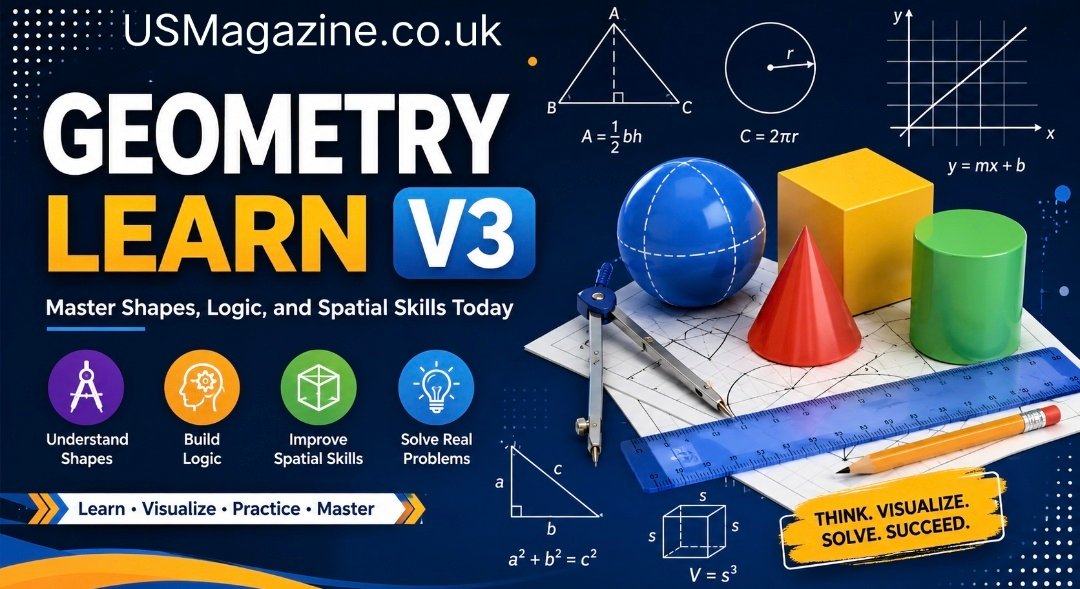
Mathematics becomes far more engaging when learners can visualize concepts instead of memorizing formulas. geometry learn v3 offers an approach that encourages curiosity, strengthens logical thinking, and transforms abstract ideas into practical understanding. Whether you are a student, teacher, or lifelong learner, developing geometric knowledge opens doors to stronger analytical skills and improved problem-solving abilities. From recognizing simple shapes to understanding complex theorems, geometry influences architecture, engineering, technology, and everyday decision-making. Learning geometry through structured methods creates confidence while making mathematical concepts easier to understand and apply in real-life situations.
Understanding the Foundation of Geometry
Geometry is one of the oldest branches of mathematics and focuses on the study of shapes, sizes, angles, dimensions, and the relationships between different objects. Ancient civilizations used geometric principles to construct buildings, measure land, and navigate across vast distances. Over centuries, these concepts evolved into a well-organized mathematical discipline that supports countless scientific discoveries and technological innovations. Understanding the foundations helps learners appreciate why geometry remains relevant in modern education and professional careers.
Every geometric concept begins with the simplest elements, including points, lines, rays, and planes. These basic components combine to form polygons, circles, solids, and more advanced structures studied in higher mathematics. As learners progress, they begin exploring symmetry, congruence, similarity, transformations, and coordinate geometry. Building knowledge step by step ensures that complex topics become easier to understand while creating a strong mathematical foundation for future learning in algebra, calculus, physics, and engineering.
READ MORE: Geekzilla Tio Geek: The Ultimate Guide for Modern Tech Lovers
Why Geometry Learn V3 Improves Mathematical Thinking
A structured learning approach such as geometry learn v3 helps students move beyond memorization by encouraging logical reasoning and visual analysis. Instead of simply applying formulas, learners understand why mathematical relationships exist. This method develops deeper comprehension, making it easier to solve unfamiliar problems and approach challenging questions with confidence. Interactive learning experiences also increase motivation and reduce the anxiety that many students associate with mathematics.
The emphasis on visualization strengthens spatial reasoning, which is valuable far beyond the classroom. Learners begin recognizing geometric patterns in architecture, maps, engineering designs, and natural environments. As they explore relationships between shapes, measurements, and transformations, they become better at analyzing information logically. This improvement extends to subjects such as computer science, robotics, design, and data visualization, where geometric thinking plays a significant role in solving real-world challenges.
Essential Geometry Concepts Every Learner Should Master
A successful understanding of geometry depends on mastering several core concepts before progressing to advanced topics. Students should first become comfortable identifying different types of angles, triangles, quadrilaterals, polygons, and circles while understanding their unique properties. Knowledge of perimeter, area, surface area, and volume also provides the practical skills needed to solve everyday measurement problems. These concepts serve as the building blocks for more sophisticated mathematical reasoning.
Coordinate geometry introduces another important dimension by combining algebra with geometric visualization. Learners discover how equations represent lines, curves, and geometric figures on a coordinate plane. They also explore distance formulas, midpoint calculations, slopes, and graphing techniques that connect mathematics to practical applications. Mastering these skills improves analytical thinking and prepares students for advanced mathematical subjects that require precision and logical problem-solving abilities.
Developing Strong Spatial Reasoning Through Practice
Spatial reasoning is the ability to mentally visualize objects, understand their relationships, and predict how they change when rotated, reflected, or transformed. This cognitive skill plays a crucial role in engineering, architecture, medicine, manufacturing, graphic design, and scientific research. Developing spatial awareness begins with simple visualization exercises and gradually progresses toward interpreting complex diagrams, three-dimensional figures, and geometric transformations with greater accuracy.
Consistent practice strengthens these abilities over time. Drawing shapes, constructing diagrams, solving puzzles, and using geometric models encourage learners to think critically while improving visualization skills. Digital learning platforms, interactive simulations, and hands-on activities further enhance understanding by allowing students to manipulate figures and observe mathematical relationships directly. As confidence grows, learners become more capable of solving challenging problems with speed and precision.
Applying Geometry in Everyday Life and Modern Careers
Geometry is deeply connected to daily experiences, often without people realizing it. Interior designers calculate room dimensions to maximize functionality, architects rely on geometric principles when creating stable structures, and engineers use precise measurements to develop bridges, vehicles, and machinery. Even photographers, artists, and fashion designers apply concepts such as symmetry, proportion, and perspective to produce visually appealing work that balances creativity with mathematical precision.
Technology has further expanded the importance of geometric knowledge. Computer graphics, video game development, virtual reality, robotics, geographic information systems, and artificial intelligence all depend on accurate spatial calculations. Medical professionals use three-dimensional imaging to diagnose diseases, while manufacturers rely on geometric modeling to design products efficiently. These applications demonstrate that geometry is far more than an academic subject; it is an essential tool that supports innovation across countless industries.
Building Confidence with Effective Learning Strategies
Success in geometry depends more on understanding concepts than memorizing formulas. Students benefit from approaching each lesson with curiosity, asking questions whenever confusion arises, and reviewing foundational ideas before moving to more advanced material. Breaking complex problems into smaller steps reduces frustration while helping learners identify logical connections between different mathematical principles. Consistent practice gradually transforms challenging topics into familiar concepts that can be applied confidently.
Visual learning techniques further improve comprehension by making abstract ideas easier to interpret. Sketching diagrams, using colored annotations, manipulating physical models, and exploring interactive educational software encourage active engagement with mathematical concepts. Collaborative learning also provides opportunities to discuss different solution methods, strengthening reasoning skills through explanation and peer interaction. These strategies create a supportive learning environment that promotes long-term understanding instead of short-term memorization.
Overcoming Common Challenges in Geometry Learning
Many students struggle with geometry because they attempt to memorize procedures without understanding the reasoning behind them. This often leads to confusion when facing unfamiliar problems or slightly different question formats. Focusing on conceptual understanding helps learners recognize patterns, identify relationships, and apply knowledge flexibly across various situations. Patience and consistent practice remain essential components of mastering geometric reasoning and improving overall mathematical confidence.
Another common obstacle involves visualizing three-dimensional objects and interpreting diagrams accurately. Learners can overcome this challenge by using physical models, educational applications, and drawing exercises that improve spatial awareness. Reviewing mistakes carefully also contributes to growth by revealing misconceptions that might otherwise remain unnoticed. Treating errors as learning opportunities encourages resilience while helping students refine their analytical thinking and strengthen their mathematical abilities over time.
Conclusion
Mastering geometry is about much more than solving equations or remembering formulas. It develops logical reasoning, visual intelligence, analytical thinking, and problem-solving abilities that benefit learners throughout their academic and professional lives. By following a structured approach like geometry learn v3, students can build confidence while exploring mathematical concepts through understanding rather than memorization. Consistent practice, curiosity, and a willingness to learn from mistakes transform geometry into an engaging subject that supports success across science, technology, engineering, design, and countless real-world applications. With dedication and the right learning strategies, every learner can develop the skills needed to understand shapes, measurements, spatial relationships, and mathematical reasoning with lasting confidence.
FAQs
1. What is Geometry Learn V3?
Geometry Learn V3 is a structured approach to learning geometry that helps students understand shapes, angles, measurements, and spatial reasoning through logical concepts instead of rote memorization.
2. Who can benefit from Geometry Learn V3?
Geometry Learn V3 is suitable for students, teachers, and anyone who wants to improve their geometry knowledge, mathematical thinking, and problem-solving skills.
3. What topics are covered in Geometry Learn V3?
It typically focuses on essential geometry concepts such as points, lines, angles, triangles, polygons, circles, coordinate geometry, transformations, area, perimeter, surface area, and volume.
4. Why is geometry important in everyday life?
Geometry is used in architecture, engineering, construction, graphic design, computer graphics, robotics, navigation, and many other fields where accurate measurements and spatial understanding are essential.
5. How can I improve my geometry skills effectively?
You can improve your geometry skills by practicing regularly, drawing diagrams, understanding concepts instead of memorizing formulas, solving different types of problems, and using interactive learning tools to strengthen spatial reasoning.


The search for the rox.com products catalog usually starts with a simple question: what exactly is ROX selling, and where do those offers live? The answer is more interesting than a basic store page, because ROX is built as a mix of mobile packages, rewards, perks, deals, and app-based experiences rather than a single product shelf. Its official pages currently point people to ROX Connect, Vault, add-ons, High Street, Life, and Arena, which means the catalog is wider than many buyers first expect.
That is exactly why the rox.com products catalog matters to anyone trying to compare options quickly. If you only look for “plans,” you may miss perks, sharing features, event access, or shopping offers that change the real value of the package. The official brand positioning also shows that ROX is meant for a digital-first audience that wants more than connectivity alone.
What the rox.com products catalog really is
The rox.com products catalog is not a traditional ecommerce catalog in the usual sense. Instead of only listing physical items, it combines telecom-style bundles with digital benefits, lifestyle access, and app-based extras. ROX describes itself as “more than a network,” and its live site organizes the offer around packages, vault-style perks, add-ons, and experiences.
That structure matters because it changes how a buyer should read the page. Someone searching the rox.com products catalog may be looking for a plan, a discount, a reward, or a shopping item, and all of those can live under the same brand umbrella. ROX’s official app pages reinforce that idea by showing ROX Connect, ROX Vault, ROX Life, ROX High Street, and ROX Arena as the main user paths.
READ MORE: Magfusehub com: What It Is and Why It Matters
The main catalog groups you will see
ROX Connect is the core part of the rox.com products catalog for many users. On the live site, it is presented as the place for packages, vault access, and add-ons, with plans such as Just Vibe, Basic Vibe, Crazy Vibe, Insane Vibe, and Share Vibe. Those names are not random branding; they point to different data, SMS, and minutes mixes so buyers can choose according to usage instead of guessing from a single generic bundle.
Beyond the base packages, the catalog also stretches into lifestyle features. ROX Vault is tied to perks, discounts, and giveaways, while ROX Life focuses on events, concerts, gaming tournaments, and exclusive merchandise. ROX High Street is where shopping and branded deals come into play, and ROX Arena is the games-and-rewards layer that gives the app a more interactive feel.
Why the rox.com products catalog feels like an app, not a storefront
A normal product catalog usually asks a buyer to browse, add to cart, and check out. The rox.com products catalog works differently because the app sits at the center of the experience, and the official description frames it as a place to manage mobile usage, access perks, and explore experiences in one flow. That is why ROX feels closer to a lifestyle dashboard than a simple shopping site.
That app-first model also changes how the catalog is updated and used. Instead of treating every offer as a one-time purchase, ROX ties many items to active usage, rewards, and renewal cycles, which means the buyer has to think about ongoing value. The rox.com products catalog is therefore less about one product and more about a connected system of plans, benefits, and app actions.
How to compare options inside the catalog
The smartest way to read the rox.com products catalog is to start with your real usage. If you need more data than calls, look at the GB amount first and ignore the flashy naming until the end. If you make more calls than you stream, then minutes and SMS should matter more than the highest data number on the page. The best package is the one that matches your habits, not the one with the loudest name.
Another useful step is to compare whether the package is personal or shared. ROX has a Share Vibe option that is built for group use, and the catalog also mentions adding contacts from the app after subscription. That makes the rox.com products catalog more flexible than a plain one-user bundle, but it also means you need to read the sharing rules carefully before choosing.
What ROX package names are trying to tell you
The package names in the rox.com products catalog are built around lifestyle language, not technical jargon. Just Vibe, Basic Vibe, Crazy Vibe, Insane Vibe, and Share Vibe are designed to feel easy to remember, but they also hint at different levels of usage and ambition. That kind of naming works well for younger audiences because it makes the catalog feel less stiff and more personal.
Names like these can help, but they can also hide the real decision points if a buyer is not paying attention. A friendly title does not tell you whether the package is right for streaming, gaming, calling, or group sharing, so the rox.com products catalog still needs a careful read. The better habit is to use the name as a label and the included benefits as the actual decision tool.
Where shopping fits into the rox.com products catalog
The shopping side of the rox.com products catalog is what makes it different from a standard telecom page. ROX High Street is described in the app store listing as a place for handpicked deals from fashion and handset brands, which means the catalog is not limited to connectivity alone. In recent ROX updates, the brand has also highlighted authentic Apple products available through the app, showing that the catalog can stretch into premium device shopping as well.
That broad mix can be useful, but it also needs a careful approach. If you land on the rox.com products catalog expecting a clean electronics store, you may be surprised to see plan bundles, rewards, event perks, and shopping offers side by side. The real strength of the platform is that it tries to connect those pieces into one user journey instead of forcing people to jump between separate services.
What buyers should check before choosing anything
Before you subscribe or order through the rox.com products catalog, check the renewal behavior first. ROX’s own FAQ includes topics like auto-resubscription, package sharing, add-ons, roaming, and support, which tells you that the details matter as much as the headline offer. If you skip those details, a package can look cheap on paper and still feel inconvenient later.
Support access matters too, especially if the catalog item is tied to usage or active app management. The live package page lists contact options, and the app store review section shows that some users have raised concerns about usability and repeating subscription steps. Those reviews are personal opinions, not final verdicts, but they do show why checking the small print in the rox.com products catalog is a smart move.
Where people often misunderstand the catalog
One common mistake is treating the rox.com products catalog like a normal online shop and expecting every item to behave the same way. A plan, a perk, a reward, and a shopping offer do not work like identical products, even when they sit under the same brand. ROX is built as a connected ecosystem, so the buyer needs to understand which part of the catalog they are using before making a choice.
Another misunderstanding comes from assuming the catalog is only for telecom users. The brand messaging on the official site and in the Jazz launch coverage shows a much broader goal: packages, exclusive deals, concerts, gaming, sports, and rewards for a digital-first audience. That is why the rox.com products catalog can feel bigger than a phone plan page and more like a lifestyle hub.
How to get better value from the catalog
The best way to use the rox.com products catalog is to match it to your own pattern of use. Heavy streamers should care about data first, frequent callers should study minutes first, and group users should check whether share features make the price easier to justify. When a catalog mixes benefits this broadly, value comes from fit rather than from a single big number on the screen.
A second value tip is to think beyond the package itself. ROX Vault, ROX Life, ROX High Street, and ROX Arena can add value only if you actually use them, so it helps to ask whether the extra layer will matter in your day-to-day routine. The rox.com products catalog is strongest for people who like all-in-one digital experiences, not for buyers who want a single, narrow utility.
Who the rox.com products catalog suits best
The official launch messaging made it clear that ROX was built for Pakistan’s digital-first generation. That means the rox.com products catalog is likely to appeal most to younger users, mobile-heavy users, and people who like apps that mix utility with lifestyle perks. It also fits buyers who enjoy rewards, deals, and event access alongside basic connectivity.
For someone who only wants a plain, old-style telecom bundle, the catalog may feel busier than necessary. For someone who likes to manage plans, perks, shopping, and experiences in one place, it can feel much more useful than a standard package list. That is the real reason the rox.com products catalog stands out: it is built for a wider daily routine, not just a single transaction.
Search tips for finding the right ROX page
If you are trying to navigate the rox.com products catalog, start with the official ROX site and the FAQ page instead of random reposts. The site already separates packages, package sharing, add-ons, ROX Vault, ROX Highstreet, events, sports, rewards, roaming, and auto-resubscription into clear areas, which makes it easier to find the right path fast. That structure is a better guide than scattered screenshots or old social posts.
It also helps to search by the feature you want rather than by the brand name alone. Queries like ROX Connect, ROX Vault, ROX High Street, package sharing, and auto-resubscription usually lead you to the right section faster than a broad search for the rox.com products catalog. Once you know the category, the rest of the decision becomes much easier.
Conclusion
The rox.com products catalog is best understood as a connected system, not a simple list of things for sale. It brings together mobile packages, shared plans, perks, shopping, rewards, and experiences under one brand, which is why it feels larger than a normal catalog page. Once you know that structure, comparing ROX becomes much easier and much less confusing.
For buyers, the main rule is simple: read the benefits, check the renewal details, and choose the part of the rox.com products catalog that fits your real use. The people who get the most out of it are the ones who care about both utility and extras, not just one of them. That is where the catalog has the most value, and that is where it makes the most sense to spend time comparing carefully.

People searching for magzyminutes.com usually want a clear picture of the site, not a vague summary stuffed with buzzwords. Based on its homepage, MagzyMinutes presents itself as an independent digital media platform built for readers who want clear, practical understanding across business, technology, finance, legal topics, education, lifestyle, and home improvement. The site’s own wording shows a strong focus on making information easier to read and more useful in daily life. That matters because a lot of modern content feels crowded, rushed, and hard to trust. magzyminutes.com stands out only if it truly delivers clarity, relevance, and reader value in a way that feels natural.
What magzyminutes.com Is Built to Do
magzyminutes.com is designed around a simple idea: help readers understand useful topics without making them work too hard. Its homepage says the platform focuses on clarity, context, and practical understanding, and that message appears throughout the site’s main sections. The brand is not presented as a narrow niche blog, but as a broader digital media space that brings together subjects people deal with in everyday life. That makes the site feel more like a modern online magazine than a single-topic publication.
The name itself also gives away the goal. The “minutes” part suggests quick reading, while the overall structure points toward short, readable content that respects the reader’s time. That is a smart choice in a digital space where people often skim, search fast, and leave quickly if the page feels heavy. magzyminutes.com seems built for readers who want useful information in a format that is easy to move through. The site says its content is meant to be understood in minutes rather than hours, which matches that reading style well.
READ MORE: Magfusehub com: What It Is and Why It Matters
The Main Topics Covered on magzyminutes.com
One of the clearest things about magzyminutes.com is its wide topic mix. The homepage lists business insights, technology trends, finance awareness, legal information, education guides, lifestyle content, and home improvement ideas as part of the site’s coverage. That range gives the platform a broad editorial identity instead of a single audience lane. Readers can come for one topic and still find something else useful without leaving the site.
That broad structure matters because real readers rarely live inside just one subject. Someone interested in technology may also want finance advice, while a student may also care about productivity, career learning, or digital tools. magzyminutes.com is positioned to serve that kind of mixed reading habit. The site’s homepage suggests that it aims to connect everyday concerns rather than separate them into isolated buckets. That approach makes the platform feel practical and flexible.
Why the Site Feels Reader-Friendly
A big part of the appeal of magzyminutes.com is its promise of simplicity. The site says it avoids unnecessary complexity and tries to keep explanations clear, structured, and human-centered. That matters because many readers do not want a wall of technical language before they understand the main point. They want content that gets to the answer, explains the context, and moves on without wasting time.
The structure of the homepage supports that idea. Each section uses plain language and short explanations, which makes the site easier to scan on desktop and mobile. That kind of format is especially helpful for readers who browse during short breaks or while multitasking. It also makes the content more suitable for people who prefer direct reading over long-form analysis. A clean structure usually helps a site feel more trustworthy and less tiring.
Who magzyminutes.com Is Best For
magzyminutes.com appears to be aimed at everyday readers who want general knowledge that still feels useful. The site’s own description makes it clear that it is built for people who want to make better decisions in life, work, and learning. That opens the door for students, professionals, small business owners, freelancers, and casual readers who want something more practical than entertainment-only content. The broad topic range supports that audience mix well.
Students may like the education and learning sections because the site says it covers study tips, online education trends, skill development, career learning paths, and productivity techniques. Professionals may be drawn to the business and finance sections because those areas often help with daily decision-making. Lifestyle readers may find value in the personal development and modern living content, especially when they want ideas that are simple instead of overly polished. The platform seems to serve readers who like variety but still want a steady tone.
Business and Finance Content on magzyminutes.com
Business content on magzyminutes.com is described as simple and practical, not overly technical. The homepage says the site breaks business topics into readable insights and focuses on market changes, startup culture, digital business models, entrepreneurial strategies, and industry trends. That is useful for readers who want to understand what is happening without being buried in jargon. It also suggests that the site is trying to translate business language into everyday meaning.
Finance content follows the same pattern. The site says it covers personal finance basics, budgeting and saving, digital banking trends, investment awareness, and economic changes. Rather than presenting itself as a source of formal financial advice, magzyminutes.com says its goal is financial awareness. That difference matters because awareness content can help readers become more informed, while still leaving big money decisions to qualified professionals.
Technology Topics That Fit the Site
Technology is one of the strongest parts of the magzyminutes.com identity. The homepage says the site covers artificial intelligence and automation, digital tools and software, cybersecurity awareness, tech industry updates, and internet culture. That gives the platform a modern tech angle without turning it into a deeply technical publication. The focus is less on expert-level engineering detail and more on how technology affects work, learning, and daily life.
That approach is useful because most readers do not need a full technical breakdown for every new trend. They need to know what a tool does, why it matters, and whether it changes anything in real life. magzyminutes.com appears to organize its tech coverage around impact, which is a smart way to make information easier to understand. A reader can quickly decide whether an update is useful, risky, or simply interesting. That kind of framing is often more valuable than a long technical lecture.
Legal and Education Sections Add Extra Value
Legal topics are usually hard for general readers because the language is often dense and formal. magzyminutes.com says it tries to simplify legal information by covering consumer rights, digital laws and online safety, workplace regulations, and general legal processes. That makes the site more accessible for people who want basic awareness without opening a law textbook. The key value here is clarity, not legal complexity.
Education content gives the platform another useful layer. The homepage says the site includes study tips, online education trends, skill development guidance, career learning paths, and productivity techniques. That mix works well for people who are actively trying to improve their skills or move into a new stage of learning. It also fits the site’s larger theme of making knowledge easier to use in everyday life. A site that supports both learning and practical action often keeps readers coming back.
Lifestyle and Home Improvement Make the Site Feel Broader
Lifestyle content on magzyminutes.com is framed around real life rather than polished fantasy. The homepage mentions daily productivity habits, work-life balance, mental clarity, digital lifestyle trends, and personal development ideas. That kind of coverage matters because many readers want simple ways to make daily routines feel lighter and more organized. The site is not trying to sound dreamy or overly inspirational; it is trying to be helpful in a grounded way.
Home improvement adds another practical angle. magzyminutes.com says it covers home organization, affordable improvement tips, interior inspiration, smart living ideas, and maintenance basics. That gives the site a useful everyday dimension because home content often appeals to people who want quick wins, not expensive overhauls. The focus on simple improvements fits the platform’s broader style very well. Readers looking for easy, realistic suggestions are likely to find that section more approachable than highly polished design content.
How to Judge the Content on magzyminutes.com
Readers should look at magzyminutes.com the same way they would judge any general content platform: by the quality of the explanation, not just by the headline. A useful article should answer the main question quickly, stay on topic, and give enough detail to make the information worth reading. The site’s own homepage says it values practical relevance, simple structure, and useful insights, so those are the standards the content should meet. If a page feels vague or padded, it is probably weaker than the brand promise suggests.
Trust also depends on how well the article matches the reader’s need. A strong business piece should explain the real-world effect of a trend, while a tech piece should connect the tool to daily use. A finance post should inform without pretending to replace professional advice, and a legal explainer should stay clear about what it can and cannot do. magzyminutes.com says it aims for readability and practical understanding, so the most useful posts will be the ones that stay close to that promise.
Why This Kind of Site Works Well in Search
Sites like magzyminutes.com often perform well when they stay broad but organized. Search engines and AI answer systems tend to understand pages better when the topics are clearly grouped and the writing explains how each subject fits the bigger picture. The homepage already shows a wide content map with business, technology, finance, legal, education, lifestyle, and home improvement sections. That gives the brand enough topic depth to build a strong identity if the articles stay consistent and genuinely useful.
The same structure also helps readers who do not arrive with a fixed plan. Someone may search for one topic and then discover another useful article on the same site. That kind of experience works especially well for magazine-style platforms because the reader can move naturally from one interest to another. magzyminutes.com seems built for that kind of browsing behavior, where simple reading leads to more reading. A site that makes discovery feel easy usually has a better chance of keeping attention.
What a Smart Reader Should Expect Next
A smart way to use magzyminutes.com is to treat it as a general knowledge hub rather than a specialist database. The homepage suggests a platform that wants to simplify information across several important topics, and that is a strong position for casual readers and practical learners. The best experience will come from articles that stay clear, specific, and grounded in real use. Readers who like short, readable explanations will probably find the format appealing.
Another good expectation is variety. Since the site covers several categories, readers can return for different needs instead of depending on one niche alone. That flexibility is part of the brand’s identity and one of the reasons magzyminutes.com feels more like a digital magazine than a single-purpose blog. If the editorial quality stays steady, that variety can become a real strength. The platform’s own language suggests that it wants to grow as a trusted source of easy-to-understand information.
Conclusion
magzyminutes.com is presented as an independent digital media platform built around clarity, practical value, and broad everyday usefulness. Its homepage shows a wide range of topics, including business, technology, finance, legal awareness, education, lifestyle, and home improvement, all written in a way that aims to be simple and reader-friendly. That makes the site appealing to people who want quick understanding without losing the bigger picture. For readers who prefer clear explanations over heavy language, magzyminutes.com has a straightforward and practical identity.

Making informed financial decisions has become increasingly challenging in a world shaped by economic uncertainty, technological innovation, and rapidly changing markets. Whether someone is building a personal budget, launching a startup, or exploring investment opportunities, reliable information plays a vital role in long-term success. fundfireinsight.com is an online publication that focuses on simplifying finance, business, entrepreneurship, investing, and economic topics through educational content that is accessible to readers with different levels of experience. By presenting practical explanations instead of overwhelming technical language, the platform encourages readers to strengthen their financial knowledge and make more confident decisions.
Understanding the Purpose of fundfireinsight.com
At its core, fundfireinsight.com is designed to make financial knowledge easier to understand. The platform publishes articles covering personal finance, investing, entrepreneurship, business development, financial technology, and broader economic trends. Rather than concentrating on a single niche, it brings together multiple financial disciplines that often influence one another. This approach helps readers understand how business, investments, markets, and the economy are connected while offering practical insights that can support everyday financial decision-making.
READ MORE: tui flight by6754 emergency landing: Inside the Emergency That Ended Safely
Broad Coverage Across Finance and Business
One of the platform’s strengths is its wide range of educational topics. Readers can find discussions related to budgeting, saving, wealth management, investment strategies, startup guidance, market developments, leadership, and business growth. The content is written for people who want to expand their financial understanding without needing advanced professional knowledge. By combining personal finance with entrepreneurship and market analysis, fundfireinsight.com creates a resource that serves students, professionals, investors, entrepreneurs, and small business owners alike.
Making Complex Financial Topics Easier to Understand
Financial terminology often discourages beginners from learning about money management or investing. The editorial approach of fundfireinsight.com focuses on explaining concepts in straightforward language while maintaining professional accuracy. Instead of presenting complicated theories alone, articles aim to provide context, practical examples, and useful explanations that readers can relate to their own financial situations. This educational style makes complicated subjects feel less intimidating and encourages continuous learning rather than short-term speculation.
Supporting Better Financial and Investment Decisions
Financial education is valuable because nearly every major life decision involves money. Whether someone is preparing for retirement, reducing debt, building an emergency fund, or creating an investment portfolio, informed decisions generally lead to stronger long-term outcomes. fundfireinsight.com emphasizes responsible financial planning by encouraging readers to understand risk, diversify investments where appropriate, and focus on sustainable financial habits instead of unrealistic expectations. This balanced perspective supports thoughtful decision-making across different financial goals.
Business, Entrepreneurship, and Innovation
Modern businesses operate in an environment shaped by digital transformation, changing customer expectations, and global competition. Entrepreneurs need knowledge that extends beyond product development to include financial planning, marketing, leadership, and operational efficiency. The platform explores these areas by discussing practical business strategies, startup development, innovation, and emerging technologies. Readers interested in entrepreneurship can gain a broader understanding of the challenges and opportunities involved in building sustainable businesses in today’s competitive marketplace.
The Importance of Economic Awareness
Economic developments influence households, businesses, and investors every day. Changes in inflation, interest rates, employment conditions, consumer spending, and financial markets affect personal budgets as well as long-term investment decisions. fundfireinsight.com explains these broader economic trends in language that is easier to understand, helping readers connect financial news with real-world consequences. Developing this awareness enables individuals to evaluate changing market conditions with greater confidence and perspective.
Digital Publishing and Educational Value
The growing popularity of online learning has increased demand for trustworthy digital publications that present reliable financial information in an accessible format. fundfireinsight.com contributes to this trend by publishing educational articles that encourage readers to continue improving their financial literacy. While publicly available information about the platform’s ownership, audience size, partnerships, or financial performance remains limited, its focus on educational content reflects the increasing importance of digital resources that simplify finance and business concepts for everyday readers.
Conclusion
Financial literacy has become one of the most valuable skills for individuals, investors, entrepreneurs, and business leaders. As economic conditions continue changing, access to understandable and practical information becomes increasingly important. fundfireinsight.com serves as an educational platform that brings together finance, business, investing, entrepreneurship, and economic insights in a reader-friendly format. Although some corporate details about the website are not publicly available, its emphasis on clear explanations and practical learning makes it a useful destination for readers seeking to strengthen their financial knowledge and make better-informed decisions over time.
FAQs
What is fundfireinsight.com?
fundfireinsight.com is an online publication that shares educational content related to finance, business, investing, entrepreneurship, financial technology, and economic developments, helping readers better understand complex financial topics.
Who can benefit from reading fundfireinsight.com?
The platform is suitable for students, professionals, entrepreneurs, investors, and small business owners who want practical financial knowledge presented in clear language without unnecessary complexity.
Does fundfireinsight.com provide financial advice?
The website primarily offers educational and informational articles intended to improve financial understanding. Readers should conduct their own research or consult qualified professionals before making important financial decisions.
What subjects are commonly covered on the platform?
Its articles typically explore personal finance, investing, business development, entrepreneurship, financial planning, market analysis, financial technology, and economic trends that influence individuals and businesses.
Why is financial education important today?
Financial education helps people understand budgeting, investing, borrowing, saving, retirement planning, and economic changes. Strong financial knowledge supports better long-term decisions and improves confidence when managing personal or business finances.