News
flight u22238 emergency declaration: What Happened Onboard?

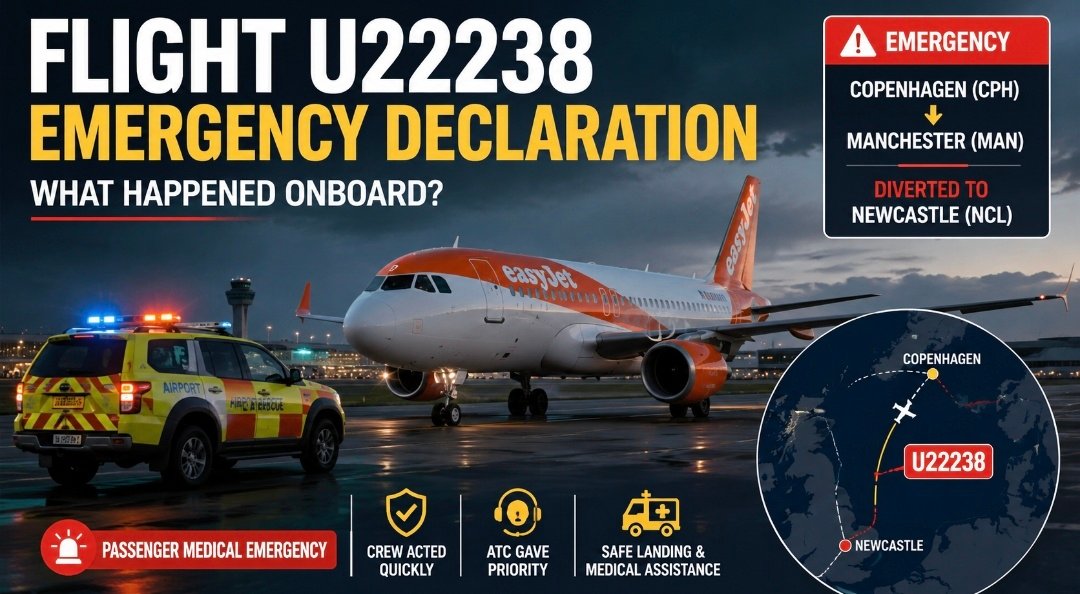
When news of the flight u22238 emergency declaration began circulating, aviation enthusiasts and travelers quickly searched for answers. Emergency declarations during commercial flights often trigger concern, but they are also an essential part of modern aviation safety. In this case, the event involved an easyJet Airbus A320 operating as flight U22238 from Copenhagen, Denmark, to Manchester, United Kingdom. Rather than indicating a catastrophic failure, the declaration allowed the crew to receive priority handling while responding to a serious onboard situation. The aircraft diverted safely to Newcastle, demonstrating how established emergency procedures are designed to protect passengers and crew even when unexpected events arise.
What Is Known About the Flight U22238 Emergency Declaration?
The flight u22238 emergency declaration occurred on 27 October 2025 during an easyJet service between Copenhagen Airport and Manchester Airport. According to airline statements and multiple aviation tracking reports, the crew declared an emergency before diverting to Newcastle International Airport. The aircraft landed safely, and no accident occurred. Reports published after the landing confirmed that the diversion resulted from a passenger requiring urgent medical attention rather than a technical malfunction or security threat.
READ MORE: Who Is Timothy Shamaly? Michigan Business Owner’s Profile
The decision reflected standard aviation practice. Pilots are trained to declare emergencies whenever doing so allows air traffic controllers to provide immediate assistance, priority routing, and faster access to emergency medical services waiting on the ground.
Why Pilots Declare an Aviation Emergency
Understanding the flight u22238 emergency declaration requires knowing how emergency declarations work in commercial aviation. A declaration does not automatically mean an aircraft is in danger of crashing. Instead, it is a communication tool that alerts air traffic control that the flight needs priority handling.
Pilots may declare emergencies because of serious medical incidents, engine abnormalities, smoke in the cabin, hydraulic problems, pressurization issues, bird strikes, or other situations requiring immediate attention. Air traffic controllers then clear surrounding traffic, coordinate emergency responders, and ensure the aircraft receives the quickest possible route to a suitable airport. This internationally recognized system has helped commercial aviation maintain one of the world’s strongest safety records.
Timeline of the Diversion to Newcastle
The flight u22238 emergency declaration unfolded after the aircraft departed Copenhagen later than originally scheduled. While en route toward Manchester, the crew identified an urgent passenger welfare situation and chose Newcastle as the safest diversion airport.
Newcastle offered appropriate runway length, emergency response capability, and rapid medical access. The aircraft landed safely shortly before 11 p.m. local time. Following the arrival, emergency personnel met the aircraft to assist the affected passenger. After refueling and completing operational requirements, the flight later continued to Manchester once conditions allowed. The diversion briefly affected nearby air traffic, with another aircraft reportedly entering a holding pattern while priority was given to the easyJet flight.
EasyJet’s Response and Passenger Welfare
Following the flight u22238 emergency declaration, easyJet confirmed that the diversion resulted from a passenger welfare issue requiring urgent medical attention. The airline apologized to travelers for the unexpected disruption while emphasizing that passenger safety remains its highest operational priority.
Commercial airlines regularly make diversion decisions even when doing so causes delays and additional operating costs. Medical emergencies cannot be predicted, and airline crews receive specialized training to stabilize situations until professional healthcare providers can meet the aircraft after landing. Although diversions inconvenience passengers, they often represent the safest and most responsible course of action.
The Aircraft Operating Flight U22238
The flight u22238 emergency declaration involved an Airbus A320 operating one of easyJet’s scheduled services between Copenhagen and Manchester. The Airbus A320 family is among the world’s most successful narrow-body aircraft, with thousands serving airlines across Europe, North America, Asia, Africa, and the Middle East.
EasyJet has built much of its network around the A320 family because of its efficiency, operational reliability, and passenger capacity. Aviation records show that flight U22238 operates this international route regularly under normal conditions. The aircraft itself was not reported to have suffered a mechanical failure during the emergency diversion.
How Air Traffic Control Supports Emergency Flights
One of the lesser-known aspects of the flight u22238 emergency declaration is the critical role played by air traffic controllers. Once pilots declare an emergency, controllers immediately reorganize surrounding traffic to minimize delays for the affected aircraft.
This coordination includes providing direct routing, arranging runway availability, notifying airport emergency services, and communicating continuously with the flight crew. Airports receiving emergency aircraft prepare firefighters, ambulances, police, and medical teams before landing whenever necessary. These procedures are practiced regularly through simulations to ensure smooth coordination during real events.
Why Medical Emergencies Are Common Reasons for Diversions
Medical emergencies account for a significant percentage of commercial flight diversions worldwide. Passengers may experience heart attacks, strokes, breathing difficulties, allergic reactions, diabetic complications, seizures, or other unexpected conditions while airborne.
The flight u22238 emergency declaration illustrates why airlines act quickly in such circumstances. Aircraft carry emergency medical kits, oxygen equipment, automated external defibrillators (AEDs), and trained cabin crews capable of providing first aid. Many airlines also maintain ground-based medical advisory services that communicate directly with flight crews to help determine whether an immediate diversion is necessary. In situations where every minute matters, diverting to the nearest suitable airport can save lives.
Public Attention and Aviation Tracking
Interest in the flight u22238 emergency declaration spread rapidly through aviation tracking platforms and social media. Modern flight-tracking websites allow enthusiasts to monitor aircraft movements in near real time, making diversions highly visible.
However, early online speculation often lacks verified information. Initial reports sometimes suggest technical failures or security concerns before airlines confirm the actual reason. In this case, later official statements clarified that the emergency related to passenger medical welfare rather than an aircraft systems failure. The incident highlights the importance of relying on verified airline communications instead of unconfirmed online rumors.
Aviation Safety Lessons from the Incident
The flight u22238 emergency declaration demonstrates how commercial aviation safety depends on preparation rather than reacting only after problems become critical. Flight crews receive recurrent simulator training covering medical emergencies, aircraft failures, diversions, and emergency communications. Airport responders also conduct regular exercises to maintain readiness.
Rather than indicating that something went wrong with aviation safety, successful diversions often show that the system worked exactly as intended. Every participant—from pilots and cabin crew to controllers, dispatchers, airport firefighters, and medical personnel—plays a coordinated role in protecting lives. Events like this reinforce public confidence that commercial airlines prioritize safety above operational convenience.
Conclusion
The flight u22238 emergency declaration became widely discussed because emergency declarations naturally attract public attention. Yet the facts tell a reassuring story rather than a frightening one. The easyJet crew responded professionally to an onboard medical emergency, declared an emergency to obtain priority handling, diverted safely to Newcastle, and ensured the affected passenger received urgent medical assistance. The aircraft landed without incident, demonstrating how international aviation procedures are designed to manage unexpected situations calmly and effectively. Instead of representing failure, this event serves as a real-world example of modern aviation safety systems functioning exactly as they were intended.
FAQs
What caused the flight u22238 emergency declaration?
The emergency declaration resulted from a passenger requiring urgent medical attention onboard. Airline statements confirmed it was a passenger welfare issue rather than a reported aircraft mechanical failure.
Was anyone injured during the emergency?
No reports indicated injuries caused by the aircraft itself. The aircraft landed safely, allowing emergency medical personnel to assist the passenger who required immediate healthcare attention after landing.
Why did the aircraft divert to Newcastle instead of Manchester?
Newcastle was considered the most suitable airport for an immediate landing based on the aircraft’s position and available emergency services. Diversion airports are selected according to operational safety rather than original travel plans.
Does an emergency declaration always mean the aircraft is in danger?
No. Emergency declarations can occur for medical incidents, technical concerns, weather, or operational issues requiring priority handling. Many declared emergencies conclude with completely safe landings, as happened in this case.
What happened after the aircraft landed?
Emergency responders met the aircraft, medical assistance was provided to the affected passenger, and operational procedures were completed before the flight later continued toward Manchester. The airline also apologized to passengers for the disruption caused by the diversion.


Newcastle United fans woke up to a shock on Thursday. Eddie Howe, the man who rebuilt the club over the last five years, is leaving. And the name lined up to replace him is one many casual fans had never heard of before this week: Matthias Jaissle.
The 38-year-old German is currently the head coach of Al-Ahli in the Saudi Pro League. Reports say Newcastle and Jaissle’s camp have already reached an agreement in principle, and talks are moving quickly toward a full announcement. For a club that just spent five years building stability under Howe, this is a bold and surprising change of direction.
Who Is Matthias Jaissle?
Jaissle was born in Nürtingen, Germany, in April 1988. He was never a big-name player. He spent his playing days as a centre-back, mostly in Germany’s lower divisions, including a spell with Hoffenheim, before an injury cut his career short in his mid-twenties.
His coaching journey is what makes him interesting. He started as an assistant at Danish club Brøndby, then joined the Red Bull football network, first coaching youth teams before taking charge of FC Liefering, Salzburg’s feeder club. In 2021, at just 33 years old, he was given the top job at Red Bull Salzburg.
That decision paid off fast. Jaissle led Salzburg to back-to-back Austrian league titles in 2021-22 and 2022-23, along with an Austrian Cup. He also guided the club into the Champions League knockout stage for the first time in its history, a landmark achievement for Austrian football. Along the way, he developed young stars like Karim Adeyemi and Benjamin Sesko, players who later moved on to major European clubs.
Why Newcastle Are Turning to Him Now
In 2023, Jaissle left Europe to take charge of Al-Ahli in Saudi Arabia, a club owned by the Public Investment Fund, or PIF. That is the same fund that owns Newcastle United. This shared ownership link is a big reason his move to Tyneside makes sense on paper. He already understands how the PIF group works and what it expects from its coaches.
At Al-Ahli, Jaissle has managed experienced names like former England striker Ivan Toney and ex-Chelsea goalkeeper Edouard Mendy. He has also won continental honours in Asia, adding to a reputation as one of the more promising young coaches in world football.
Howe’s exit is reported to be amicable. Sources close to the club say he simply wants a break from the game after nearly five demanding years. Newcastle’s board, though caught off guard by the timing, are said to have been quietly prepared for this scenario and moved fast to identify a successor.
Jaissle now faces the challenge of replacing a manager who took Newcastle back into the Champions League and rebuilt the club’s identity. He is younger than many players in the current Newcastle dressing room, something that worked in his favour at Salzburg, where his relatable style and focus on team spirit won players over. Whether that same approach can work in the pressure and pace of the Premier League is the question every Newcastle fan will now be asking.
Summary
Eddie Howe has left Newcastle United after five years in charge, and Al-Ahli boss Matthias Jaissle is set to take over as his replacement. The 38-year-old German built his reputation at Red Bull Salzburg, winning two Austrian titles and reaching the Champions League knockout stage for the first time in the club’s history. Since 2023, he has managed Al-Ahli in Saudi Arabia, a club under the same ownership as Newcastle, which is seen as a key factor behind the move. An announcement is expected soon as talks progress toward completion.
READ MORE: https://usmagazine.co.uk/
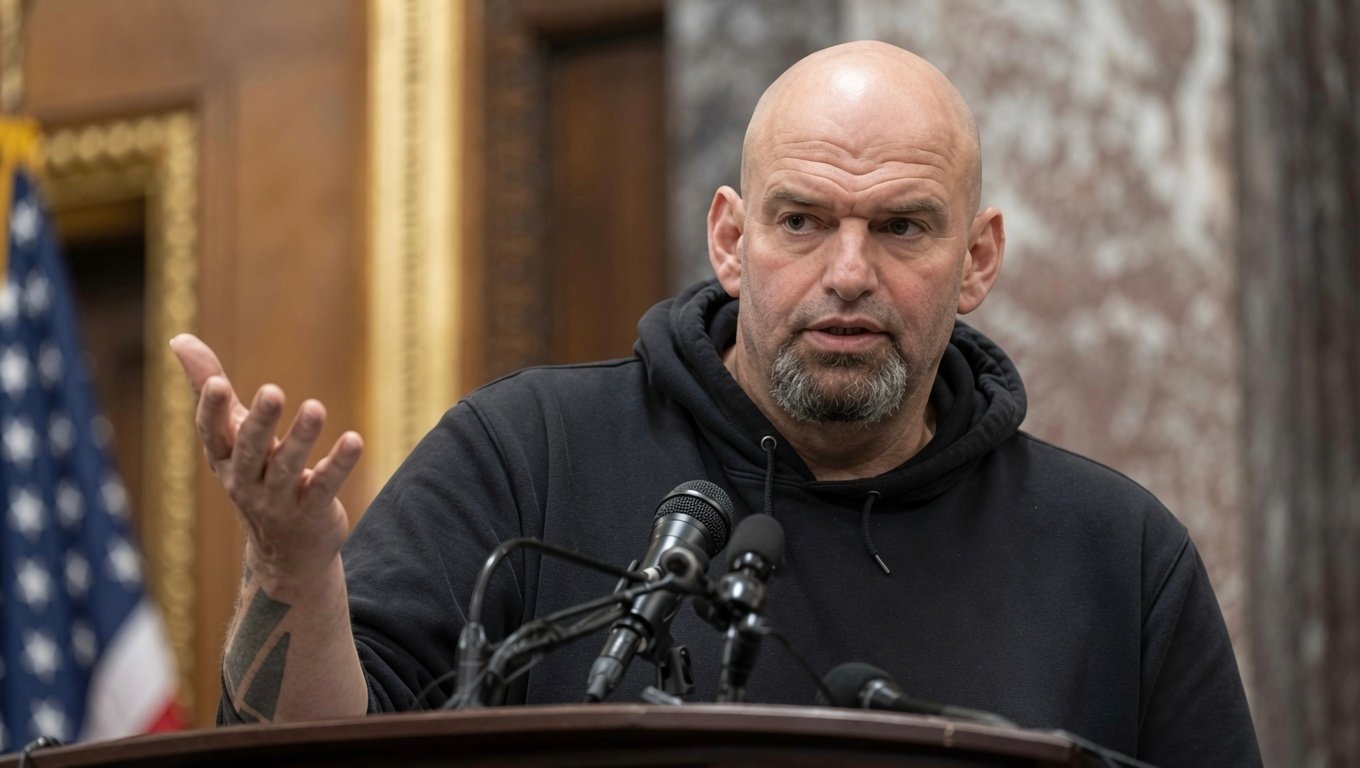
Senator John Fetterman is going through one of the roughest patches of his political career. His support for Israel, his change of heart on the filibuster, and his growing closeness with Republicans have put him at odds with fellow Democrats. With his approval among Democratic voters at a new low and talk of a 2028 primary challenge growing louder, many are now asking one big question: will John Fetterman stay a Democrat, or is a party switch coming?
A Senator Standing Apart From His Own Party
John Fetterman has never been a typical politician, and lately that has never been more true. The Pennsylvania senator has openly said he has no plans to quit the Democratic Party right now, but he has also drawn a clear red line: if Democrats ever officially become an “anti-Israel party,” he is out. He explained this stance at a public summit in Washington, D.C., saying his support for Israel has always been a matter of personal principle for him.
This is not a small disagreement. Fetterman has repeated the same warning in more than one interview recently, and he has made it clear that this issue matters more to him than staying loyal to his party’s current direction.
Frustration Growing on Both Sides
The tension is not one-sided. Fetterman has told reporters that if the Democratic caucus does not want him around anymore, party leaders should simply say so directly. This comment came out of growing frustration, as he feels his party is drifting further away from positions he strongly believes in.
At the same time, some Democratic lawmakers are unhappy with him too. He has been criticized for teaming up with his Republican Senate colleague on fundraising efforts, something fellow Democrats see as unhelpful while they try to win back competitive seats. Meanwhile, on the other side of the aisle, Senate Republican leadership has said openly that Fetterman would be welcome to caucus with them if he ever chose to leave the Democrats.
Falling Approval and a Tough Road to 2028
Adding to the pressure, a recent Quinnipiac poll showed Fetterman’s approval rating among Pennsylvania Democrats has dropped sharply, while his numbers among Republicans have jumped. That kind of split makes his political future complicated. Winning a Democratic primary would be very difficult with numbers like these, but it is far from certain that Republican voters would actually back him in a general election either.
Fetterman has also shifted his position on other big issues. He recently said he no longer supports getting rid of the Senate filibuster, a reversal from what he campaigned on back in 2022. He has also spoken about rethinking his earlier views on COVID-era decisions, saying some criticism from conservatives at the time turned out to have merit.
For now, John Fetterman remains a Democrat, and Senate Democratic leadership has publicly urged him to stay in the caucus. But with tension rising on almost every front, from Israel policy to campaign fundraising to internal party trust, it is clear his path forward will not be simple, and political watchers on both sides are paying close attention to what he does next.
READ MORE: https://usmagazine.co.uk/
Celebrity
Alaia Baldwin Aronow: Hailey Bieber’s Sister Faces Battery Charges After Georgia Bar Incident

Alaia Baldwin Aronow, the older sister of model Hailey Bieber, has been formally charged with four misdemeanors nearly two years after a nightclub altercation in Savannah, Georgia. The 33-year-old model and entrepreneur was arrested back in February 2024, and prosecutors filed official charges in January 2026. Her lawyers say they expect the case to end well for her.
Who Is Alaia Baldwin Aronow?
Alaia Baldwin Aronow was born on January 23, 1993, in Nyack, New York. She is the eldest daughter of actor Stephen Baldwin and his wife Kennya, and she is four years older than her famous sister, Hailey Bieber. The two sisters share a close bond. Alaia stood by Hailey’s side at her 2019 wedding to singer Justin Bieber, and the pair often show up together at public events.
Alaia is also known for her own work. She is a model and entrepreneur, and she serves as an ambassador for the Endometriosis Foundation of America. She has spoken openly about living with the condition, saying her goal is to be someone others can turn to when they feel alone in their pain.
In her personal life, Alaia married Andrew Aronow, founder of Pocket Ace Productions, in September 2017. Hailey served as her maid of honor. The couple welcomed a daughter, Iris Elle Aronow, in August 2020.
The Club Elan Incident and New Charges
The trouble began in February 2024 at Club Elan, a nightclub in Savannah, Georgia. According to a police report, Alaia forced her way into an employees-only bathroom even after staff told her a public restroom was available nearby. A bartender said she let Alaia use the space briefly to change a tampon, but the situation escalated from there.
Police say a confrontation broke out between Alaia and three staff members, including two bouncers and the bartender. Officers reported that she pulled at one bouncer’s hair and struck another employee, while she maintained she was only defending herself. She was arrested that night on charges of simple assault, simple battery, battery, and criminal trespassing.
Nearly two years later, in late January 2026, Georgia prosecutors formally filed the case. Alaia now faces four misdemeanor charges, and her arraignment has been set for April 23. If convicted on the battery charge, she could face up to a year in jail.
What Happens Next
Alaia’s attorneys, Drew Findling and Cris Schneider, have responded with confidence. They told reporters they remain certain the case will reach a positive outcome for their client. So far, there has been no public comment from Alaia herself on the new charges.
The timing has drawn extra attention because it comes during a period when the Baldwin family has already been in the spotlight, with father Stephen Baldwin publicly asking for prayers and support for Hailey and Justin Bieber.As the April court date approaches, fans and followers of the Baldwin family are watching closely to see how the case unfolds.
READ MORE: https://usmagazine.co.uk/