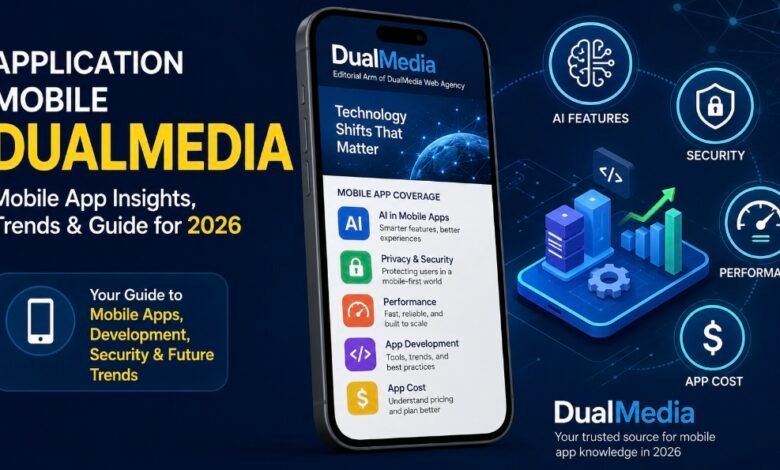
The phrase application mobile dualmedia points to a very specific kind of search intent: people want mobile-app information tied to DualMedia, not vague tech chatter. DualMedia presents itself as the editorial arm of a web agency that has covered high-tech innovation since 2000, with a focus on AI, crypto, cybersecurity, web, and mobile tech. Its mobile-app content also leans practical, with recent pages talking about app performance, privacy, AI features, app cost, and mobile development basics. That makes the topic useful for readers who want current app guidance without digging through scattered sources. If you came across application mobile dualmedia and wondered what it really means, the answer is best found by looking at the site’s mobile-first tech coverage and the way it explains apps in 2026.
What application mobile dualmedia points to
The most natural reading of application mobile dualmedia is that it refers to DualMedia’s mobile-application content and the way the brand discusses app development, app trends, and app use. DualMedia’s own site says it is the editorial arm of the DualMedia Web Agency, and it describes the publication as a place for technology shifts that matter, especially in mobile and web. That matters because the phrase does not look like a product name on its own; it looks more like a search around a content theme. Based on the site pages, the phrase seems to point to a mobile-app information hub rather than a single downloadable app.
READ MORE: do the driving modes in cadillac lyriq offer different ranges or battery usages?
That distinction is important for the reader. A mobile application can mean software built for phones, tablets, or wearables, while a content page about mobile apps explains how those apps are built, used, protected, and priced. DualMedia’s recent mobile coverage fits that broader meaning because its pages cover development, app performance, security, and user expectations instead of only one specific app. If you approach application mobile dualmedia as a topic cluster, the content becomes much easier to use.
Why DualMedia’s mobile app coverage matters
Mobile apps are no longer a side topic in tech. DualMedia’s 2026 coverage treats them as a core part of digital life, linking mobile apps to speed, privacy, AI features, and business use. One of its recent articles says users now expect apps that are fast, private, and smarter than older versions, which matches the way many teams now think about mobile experience. That makes application mobile dualmedia useful for readers who want to understand where app expectations are headed, not just what an app does today.
The site also gives mobile coverage a practical tone. Rather than framing mobile apps as abstract products, DualMedia connects them to everyday behavior such as logging in, paying, scanning, learning, or accessing services on the move. That approach helps readers see why mobile apps matter beyond the screen itself. In plain terms, the content is built for people who want to know how mobile software changes real work and real habits.
The mobile app topics DualMedia emphasizes in 2026
A clear pattern shows up in the current articles: AI, privacy, security, performance, and app usefulness. DualMedia’s mobile-app writing highlights the idea that a good app is not only attractive, but also fast, safe, and useful enough to keep people coming back. One article on app loyalty focuses on repeat use, while another on mobile app performance testing stresses reliability, device behavior, and backend quality. That tells you the site is not chasing novelty for its own sake. It is trying to explain what makes an app actually work in the real world.
AI is another major thread. DualMedia’s 2026 coverage talks about AI agents, generative coding, and how software work is changing across mobile and web. That matters because mobile app development is now tied to automation, faster prototyping, and smarter user experiences. Readers searching application mobile dualmedia are likely looking for exactly this kind of up-to-date app context.
How to read application mobile dualmedia content the right way
The easiest way to read this kind of content is to treat each article as a decision aid. Ask whether the page is explaining app development, app performance, app security, or app strategy before you decide how much attention it deserves. That matters because the same mobile topic can mean very different things to a developer, a business owner, or a casual reader. DualMedia’s pages are broad enough to support each of those audiences, but the reader still needs to know what question the article is answering.
A second useful habit is to check whether the article gives a practical outcome. Strong app content should show what changes for the user, the business, or the developer. For example, a performance article should explain how faster loading or fewer crashes improve retention, while a security article should show how to reduce risk. DualMedia’s current mobile coverage follows that pattern, which makes the site more helpful than a simple headline feed.
What counts as a mobile application here
From a technical point of view, a mobile application is software built for end users on mobile devices such as phones and tablets. DualMedia’s own mobile pages use that broad meaning, including app discussions that stretch across Android, iOS, performance, payments, and user experience. That is a sensible approach because modern apps rarely stay inside one narrow category. They often mix content, service, payment, security, and engagement in a single product.
That broader definition also helps readers understand why application mobile dualmedia is not just about “having an app.” A mobile app can be a sales channel, a support tool, a loyalty system, or a workflow layer for a business. DualMedia’s coverage makes that clear by discussing membership apps, app development, and the features that drive repeat use. Once you see mobile apps as tools with jobs to do, the topic becomes much easier to evaluate.
Security still matters more than hype
One of the strongest themes in DualMedia’s mobile writing is cybersecurity. The site’s security article on mobile app development highlights secure coding, regular testing, peer review, and frequent updates as key defenses against threats such as code injection, data breaches, and man-in-the-middle attacks. That list may sound basic, but it is exactly the kind of foundation that separates a stable app from a risky one. For readers, application mobile dualmedia is useful because it keeps security visible instead of hiding it behind feature talk.
Security also ties back to trust. Users are more willing to keep an app on their phone when they believe their data is protected and the software is maintained properly. DualMedia’s 2025 and 2026 mobile coverage reinforces that point by linking privacy, performance, and AI features to the overall app experience. The message is simple: a mobile app can be modern and still be unsafe if the basics are ignored.
Performance and privacy are now part of the same conversation
A few years ago, teams often treated speed, privacy, and features as separate goals. DualMedia’s recent mobile coverage shows that those concerns now sit together. Users expect apps that load quickly, respect their data, and still offer useful intelligence through AI-powered features. That combination is now part of the standard conversation around application mobile dualmedia and similar mobile-tech topics.
Performance testing matters because real users do not care how elegant the code looks if the app feels slow or unstable. DualMedia’s testing article focuses on device behavior, network conditions, and backend metrics, which reflects how mobile issues actually show up in daily use. Privacy matters for the same reason: users judge an app by how safe it feels during normal tasks. When both sides are handled well, retention improves and the app feels trustworthy enough to use again.
What businesses can learn from application mobile dualmedia
Businesses looking at mobile apps should read DualMedia’s content as a reminder that app value comes from fit, not just launch. A useful app solves a specific problem, makes one task easier, or gives customers faster access to something they already need. DualMedia’s article on Sam’s Club shows how a mobile app can become the main access point for a membership experience, not just an extra feature. That is a strong example of how mobile software can reshape a service.
For companies, the bigger lesson is that mobile apps should be planned around use cases, not vanity. The most effective apps usually combine speed, clear design, simple authentication, reliable payments, and a reason to return. DualMedia’s mobile coverage keeps coming back to those practical questions, which makes application mobile dualmedia a useful keyword for business-minded readers as well. The app is only valuable when people actually keep using it.
Cost is part of the decision, not an afterthought
Mobile app cost is one of the clearest reality checks in the DualMedia ecosystem. The company’s pricing page says a showcase app can start around €8,000, while a complex business platform can rise above €200,000. That range is wide for a reason: app price depends on scope, features, design, integrations, and the level of security and maintenance involved. Readers searching application mobile dualmedia often want this kind of practical context because it helps them understand what kind of project they are really talking about.
Cost also shapes expectations. A small app with limited features should not be judged by the standards of a large enterprise platform, and a large platform should not be built with a tiny budget and unrealistic deadlines. DualMedia’s pricing framing makes that clear by showing how the complexity of the app changes the investment. For anyone planning a mobile project, that is one of the most useful pieces of information on the page.
Signs that a mobile app article is worth trusting
A good app article should say what problem it solves, who it is for, and what practical trade-offs exist. DualMedia’s mobile content usually does that by tying features to user experience, security, performance, or business results. That is a better sign of quality than hype or vague praise. If a page talks only in big claims and never explains how the app works, it is less useful than it first looks.
Another trust signal is consistency. DualMedia’s site describes a long-running editorial background, hands-on experience in digital strategy and development, and a focus on technology shifts that matter. That kind of operational background does not make every article perfect, but it does give the publication more context than a generic content farm. For readers, that usually means the advice is more grounded in how mobile tech is actually built and used.
Where application mobile dualmedia fits in the bigger tech picture
The broader tech picture in 2026 is shaped by AI, mobile-first services, stronger security expectations, and more pressure to ship software that performs well from day one. DualMedia’s current editorial mix fits neatly into that picture because it covers mobile apps alongside web, AI, crypto, and cybersecurity. That is important because mobile apps no longer live on their own; they sit inside a larger digital ecosystem. A good mobile article has to recognize that reality.
Seen that way, application mobile dualmedia is not just a keyword. It is a small window into how people now search for practical tech knowledge: they want the right topic, the right level of detail, and a clear explanation of what matters now. DualMedia’s content works best when it stays close to those goals. That is why the phrase makes sense for readers who want more than surface-level app talk.
Conclusion
Application mobile dualmedia is best understood as a search around DualMedia’s mobile-app content, not a single standalone app. The site’s current coverage points to the topics readers care about most in 2026: AI, performance, privacy, security, app costs, and real-world app use. That makes the keyword useful for anyone trying to understand how mobile applications are being discussed by a tech publication with long-running web and mobile experience. The strongest takeaway is simple: useful app content should help people make better decisions, not just fill a page.