Marketing
Stop Using One AI for Everything: Build a Model-Per-Task Content Stack

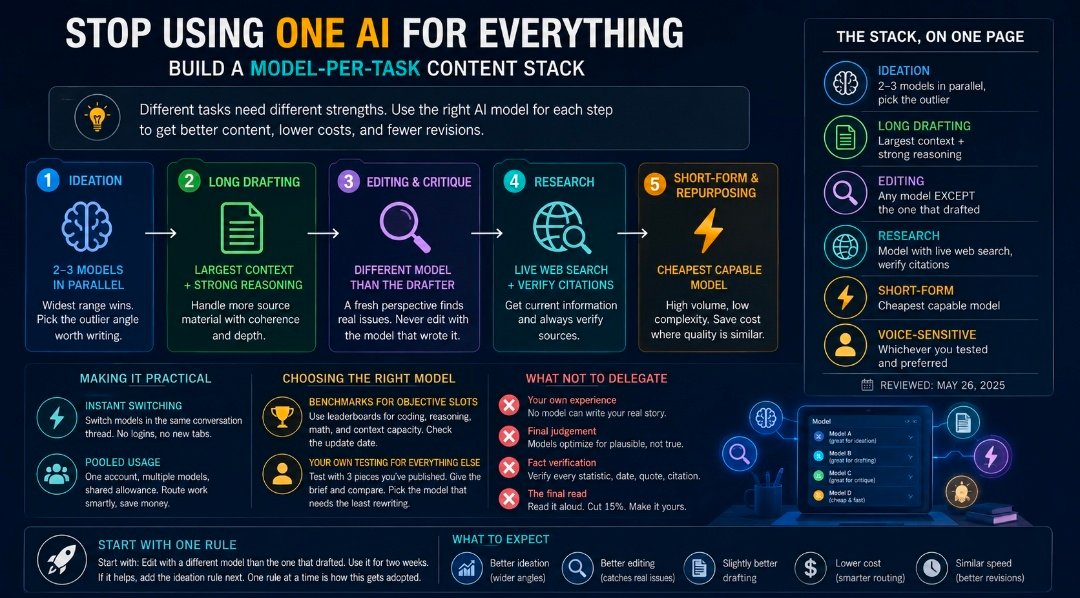
Most content teams picked an AI model in 2023, got comfortable, and have used it for everything since. Ideation, drafting, editing, research, repurposing, social captions, meta descriptions — all through the same interface, with the same model, with the same characteristic weaknesses applied uniformly to every task.
It works. It also caps your output at that model’s worst competency, applied to whichever task it happens to be worst at.
A model-per-task stack is not complicated. It is one page of rules and it typically improves output noticeably on two or three tasks where your default was quietly mediocre.
The tasks that genuinely differ
Not every content task benefits from a different model. These five do, and the differences are large enough to notice.
Ideation → widest range wins
You want unusual angles, not correct ones. The best model here is whichever produces output most different from the others, which means the right approach is running two or three in parallel rather than picking one.
Ideation is the strongest case for multi-model access in the entire content workflow. One model gives you its house angles. Three give you a choice, and the outlier is usually the one worth writing.
Long-form drafting → largest context plus strong reasoning
For pieces built on source material — interview transcripts, research documents, competitor analysis — the constraint is holding everything coherently at once. You want a large context window and strong reasoning scores, and you want to stay well under the advertised limit so quality does not degrade.
Editing and critique → a different model from the drafter
This is the highest-return rule in the stack and the one most people have never tried.
A model editing its own output is a weak critic. It generated that text because it evaluated it as good; asking it to find problems is asking it to disagree with itself. A different model has no such attachment and finds real structural issues — unsupported claims, skipped steps, a paragraph doing no work.
The rule is simple: never edit with the model that drafted.
Research and current information → live web search
Any model without live retrieval is answering from training data with a cutoff date. For anything time-sensitive — recent developments, current pricing, this quarter’s numbers — that produces confident, dated, wrong answers.
Use a model with native web search, and verify the citations regardless. Fabricated sources with plausible titles are a persistent failure mode.
Short-form and repurposing → cheapest capable model
Social captions, meta descriptions, alt text, subject lines. High volume, low complexity, minimal quality variance between models.
Running these through a frontier model is paying premium rates for clerical work. This is where the cost savings in a model-per-task stack come from.
The stack, on one page
IDEATION → 2-3 models in parallel, pick the outlier
LONG DRAFTING → largest context + strong reasoning
EDITING → any model EXCEPT the one that drafted
RESEARCH → model with live web search, verify citations
SHORT-FORM → cheapest capable model
VOICE-SENSITIVE → whichever you tested and preferred
REVIEWED → [date]
Six lines. That is the entire system.
Making it practical
The concept fails on friction. If using a second model means a second subscription and a second login, nobody does it past the first week — they open the tab that is already open and use whatever is in it.
Two requirements make a model-per-task stack survive contact with a deadline:
Switching has to be instant. Not a login, not a new tab. Ideally the same conversation thread, so you can draft with one model and immediately critique with another without re-pasting anything.
Usage has to be pooled. Under per-vendor subscriptions, using four models means four bills, and the short-form rule — route cheap work to a cheap model — becomes economically pointless because you already paid for the expensive seat.
Multi-model platforms such as Perspective AI exist to remove exactly this friction: several labs’ models behind one account with a shared allowance, switchable mid-conversation. Whatever you use, those two properties are what determine whether the stack gets used or abandoned.
Choosing which model for which slot
Two inputs, weighted differently than most people assume.
Benchmarks, for the objective slots. Coding, reasoning, and context capacity are measurable, and a maintained ranking is a reasonable starting filter. A composite model leaderboard averaging coding, maths, reasoning, and human-preference scores will shortlist candidates in a minute — read its update date first, since any such ranking is a dated snapshot rather than a permanent verdict.
Your own testing, for everything else. Prose quality, voice fit, and how well a model follows your specific brief format are not benchmarkable. Test them.
The test that works: take three pieces you have already published and are happy with. Give each candidate model the brief that produced them and compare its draft against what you actually shipped. The model whose output needs least rewriting wins the drafting slot. This takes about an hour and beats any amount of reading comparisons.
What not to delegate to any model
Worth stating plainly, because a stack this convenient invites over-delegation.
Your own experience. The paragraph about what actually happened on your project is the reason anyone reads the piece. No model can write it and every model will happily produce a generic substitute.
Final judgement on what to publish. Models optimise for plausible. Plausible and true diverge, and the divergence is invisible in well-written prose.
Fact verification. Every statistic, date, quote, and citation gets checked against a primary source. This is not a prompting problem to be solved; it is a property of how the technology works.
The final read. Reading it aloud and cutting 15% is what separates competent from good, and it is entirely yours.
What to expect
Realistic outcomes from teams that adopt a task-based stack:
- Ideation improves the most — noticeably wider range of angles
- Editing improves second — cross-model critique catches real problems
- Drafting improves modestly — mostly from better model-task fit on long pieces
- Cost drops, if you actually route short-form to cheaper models
- Speed is roughly flat — you save time on revision and spend some on switching
The biggest gain is not speed. It is that the pieces where your default model was weakest stop being the weakest pieces you publish.
Frequently asked questions
Is it worth using multiple AI models for content? Yes for ideation and editing, where cross-model differences are large. Marginal for short-form, where models perform similarly. Start with those two tasks rather than rebuilding your whole workflow.
Which AI model is best for content writing? There is no general answer — prose preference is subjective and voice fit varies by writer. Test candidates against pieces you have already published well and pick the one needing least rewriting.
Does switching models mid-project cause inconsistency? It can, if you switch drafting models mid-piece. Draft with one model throughout, then switch for critique. The inconsistency risk is in drafting, not in review.
How often should I re-evaluate my model choices? Quarterly. Rankings shift with each release cycle, but chasing every release costs more attention than it returns.
Does a model-per-task stack cost more? Usually less, if you have pooled usage and actually route high-volume short-form work to cheaper models. It costs more only if you buy separate full-price subscriptions per model.
Start with one rule
Do not build the whole stack this week. Adopt one rule: edit with a different model than the one that drafted.
Use it for two weeks on real work. If the critiques are finding things your usual process missed, add the ideation rule next. If they are not, you have learned something about your workflow and it cost you nothing.
One rule at a time is how this actually gets adopted. Six rules at once is how it gets abandoned.

-
 Blogs1 day ago
magzyminutes.com: What It Covers and Why It Matters
-
 FINANCE technology1 day ago
Fintechzoom.com Nasdaq: Your Gateway to Smarter Market Insights
-
 Blogs1 day ago
Rox.com products catalog: what buyers should know
-
 Blogs1 day ago
fundfireinsight.com: Smart Finance and Business Insights
-

 Blogs7 days ago
How DXB APPS Is Supporting Digital Transformation Through Mobile App Development in Dubai?